-
…And the Last Lion is Rescued!
LION NUMBER 25 SAVED.
ANIMAL DEFENDERS INTERNATIONAL’S RECORD BREAKING LION RESCUE SET TO REACH ROARING CRESCENDO
LOS ANGELES, Feb. 8, 2011 – The number of lions being airlifted on the record-breaking Animal Defenders International (ADI) airlift, known as Operation Lion Ark, rose this weekend to 25. A specialist ADI team flew down to Tarija in southern Bolivia and returned with an elderly lion called Kimba.
Kimba had been living in a small concrete zoo enclosure for the past 11 years after being dumped there by a travelling circus. In recent weeks, ADI and the Bolivian authorities have swooped on circuses all over Bolivia and confiscated all of their animals. Indigenous or domestic animals have been homed in Bolivia, and ADI is taking care of all the lions – now numbering 25. Bolivia’s DGB had requested ADI take the old lion.
On Friday, ADI flew down to Tarija in a C130 Hercules that had seen service in the Vietnam War. They took one of the crates that had already been prepared for the Operation Lion Ark airlift later this month.
At the zoo the ADI team had to break down a wall and cut through metal railings to get to Kimba, but he was soon lured into the travel crate by ADI President Jan Creamer. He was then driven to the airport, with members of the Tarija public applauding on the roadside, and loaded onto the TAB cargo aircraft. It was a smooth hour flight back to Santa Cruz, during which Kimba was very relaxed and showed no signs of stress, before a slow drive to the ADI Operation Lion Ark compound. The ADI team, including a vet, joined Kimba on the flight and were able to monitor him throughout.
In the ADI compound Kimba saw and heard other lions for the first time. He went straight into his new holding cage and had a meal before calling to the other lions.
Jan Creamer said: “Kimba seems a lovely, gentle old lion. He is very thin, blind in one eye, and has not seen or heard anther lion for eleven years. Once we lured him into the travel crate he settled quickly and remained relaxed throughout the flight and journey to the ADI Lion Ark compound in Santa Cruz. He’s had a sad lonely life and really deserved a break, so he is the perfect lion to be number 25 – the last lion to be saved during this huge seizure operation.
“We are now counting down to the Operation Lion Ark airlift next week when we will be taking Kimba and the other 24 lions to their wonderful new life in Colorado. ADI would like to thank TAB and the ON Group who helped us collect Kimba and who will be working with us on the main Lion Ark airlift when we will have 25 lions on one flight!”
The lions which have been rescued from circuses after Bolivia banned the use of animals in circuses will be heading for a new life at The Wild Animal Sanctuary near Denver Colorado where ADI is funding the construction of new facilities on 80 acres (over 32 hectares) of land supplied by the sanctuary.
Jan Creamer said: “Kimba’s rescue concludes part one of this amazing rescue. We now have all the lions. Now ADI must work at full speed to get them to paradise at The Wild Animal Sanctuary. These lions who have suffered so much will be able to run and play at last. Metal workers all over Santa Cruz are working flat out to prepare all the crates we need and our veterinary team are ensuring the animals are in optimum condition to fly. We have our biggest challenge next week, flying 25 lions on one aircraft to the USA!”
This dramatic lion rescue began last November when, in a series of seizures all over Bolivia, ADI working with the Bolivian authorities including the DGB and Santa Cruz Governor’s Office, started to remove the animals from different circuses spread across the country.
The moves were to enforce Bolivia’s Law 4040 which bans the use of animals in circuses, which came into force after ADI officers went undercover to expose the horrific abuse in circuses across South America. The legislation effectively shut down the country’s animal circus industry at a stroke – the first time such a thing has happened in the world.
The huge rescue operation – the first time a country’s animal circus industry has been shut down in this way – last week attracted the backing of a number of celebrities including Bob Barker, Jorja Fox, Brian Blessed, Twiggy, Joanna Lumley, Julia McKenzie, and Benjamin Zephaniah, along with Meg Mathews, Wendy Turner Webster and Prunella Scales, who have called on the public to send donations to help the rescue. For more information visit: www.savethelionsappeal.com, or call (323) 804-9920.
About Animal Defenders International
With offices in Los Angeles, London and Bogotá, Animal Defenders International campaigns to protect animals in entertainment; replacement of animals in experiments; worldwide traffic in endangered species; vegetarianism; factory farming; pollution and conservation. ADI also rescues animals in distress worldwide. ADI-gathered evidence has led to campaigns and legislative action all over the world to protect them.
ADI’s Mission: To educate, create awareness, and promote the interest of humanity in the cause of justice, and the suppression of all forms of cruelty to animals wherever possible to alleviate suffering, and to conserve and protect animals and the environment.
http://www.adiusa.org
http://www.ad-internationalorg/adi_world/ -
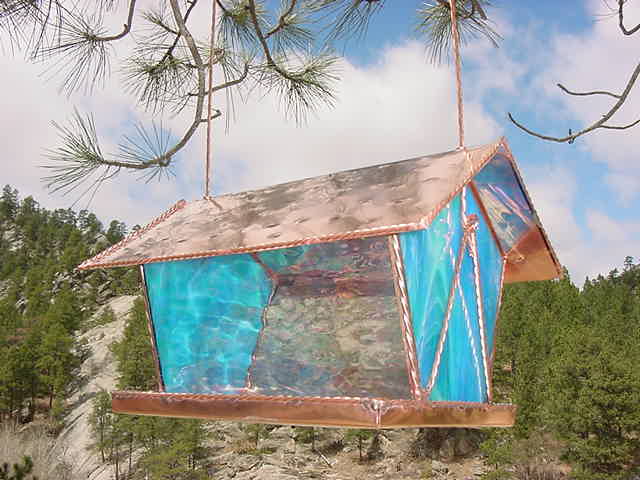
an artful glass bird feeder
 Now glass birdhouses may not be such a great idea as severe weather conditions can wreak havoc on inside temperatures. Extreme heat (if in the line of direct sun) may not be so healthy for eggs or hatchlings.
Glass bird feeders on the other hand, can add a fantastic focal point to the garden or yard. True works of art, the hand crafted glass bird feeders feature a long lost kind of art, and it shows in the craftsmanship.
This copper and stained glass bird feeder features a hand hammered roof, and the generous tray allows for multiple perching spots so several birds can feed at once. The overhang roof helps to protect seed form the elements, while the large capacity hopper holds several ponds of any seed mix. This artist features several vibrant hues of stained glass, and custom work is always a pleasure to create. If you’re stumped for a great Valentine’s gift that will last for years… and actually be admired and enjoyed, consider a work of art – a one-of-kind glass bird feeder in your choice of colors!

-
Death in the Bat Caves:
Disease Still Wiping out Hibernating BatsScientists suggest a roadmap to tackle disease which has killed over one million bats
California, February 2011 – Conservationists across the United States are racing to discover a solution to White-Nose Syndrome, a disease that is threatening to wipe out bat species across North America. A review published in Conservation Biology reveals that although WNS has already killed one million bats, there are critical knowledge gaps preventing researchers from combating the disease.
WNS is a fatal disease that targets hibernating bats and is believed to be caused by a newly discovered cold-adapted fungus, Geomyces destructans, which infects and invades the living skin of hibernating bats. Since 2006 about one million bats across six species in eastern North America have died from WNS, and as a result several species of bats face endangerment or extinction.
“White-Nose Syndrome was first documented in 2006 in a tourist cave near Albany, New York. Dead and dying bats were then found in four nearby caves, 30 km west of Albany,” said lead author Janet Foley from the University of California, Davis. “By July 2010 G.destructans was identified in hibernating bats in 13 states as well as in Ontario and Quebec across the Canadian Border.”
Affected bat species include the endangered Indiana and gray bats (Myotis sodalis and M. grisescens), little brown bat (M. lucifugus) and the cave bat (M. velifer). Infection has also been confirmed in five species of bats in Europe, although no similar epidemic has yet been recorded.
The low temperatures and humid conditions of bat caves create ideal breeding grounds for this fungus, and in some bat colonies the mortality rate from WNS has been more than 95%.
“Some bats in infected bat colonies behave abnormally when infected, choosing to hibernate in exposed places, such as cave entrances or even flying during the day,” said Foley. “Bats regularly arouse from hibernation in order to drink, urinate and relocate. This causes them to burn up their only source of energy during winter, the body fats they stored prior to winter when insect prey was still available. Fungal infection might be leading to more frequent arousals from hibernation, causing infected bats to use up their fat reserves earlier, with potentially fatal consequences.”
Although the effects of the disease are all too apparent, there are critical knowledge gaps for researchers confronted with combating the disease. It remains unclear if G. destructans is the only pathogen involved, how it causes mortality, and its means of transmission. Some evidence suggests that people can move the fungus from cave to cave.
“Our study considers how epidemiology and disease ecology can help fill these knowledge gaps,” said Foley. “We believe that a roadmap including bat monitoring and disease surveillance, coupled with active research into finding ways to treat individual bats will be vital to combating this disease.”
“Based on current data, we believe that the culling of bats would be both premature and ill-advised. Instead we see efforts to conserve the genetic diversity of bat populations, combined with a program of educating the public to be key parts of the roadmap.”
Dr Foley’s team includes bat and disease ecologists from three different public agencies and academia and tries to make the point that creative, scientifically-sound ideas will be key to the success of any management plans. The group outlines an outbreak investigation framework that includes establishment of diagnostic standards, case definitions, and gathering of information on potential treatments for similar diseases.
The importance of monitoring bat population health is also stressed, as is improving public education and awareness of the disease, especially as many species of bats live in caves popular among tourists. If current declines in bat populations continue, the researchers expect strong reductions in the ability of bats to reduce insect pests and play important ecological roles in unique cave ecosystems.
The team also call for further studies of the chemical or biological agents that can kill the fungus, but have yet to be proven safe for bats.
“In the three years since its discovery WNS has changed the focus of bat conservation in North America,” concluded Foley.. “A national response is required and our epidemiological roadmap is designed to help inform state and national efforts to combat WNS across North America.”
This study is published in Conservation Biology. Media wishing to receive a PDF of this article may contact [email protected]

Birding Tips, Information & News