-
This Season for Seed Catchers!
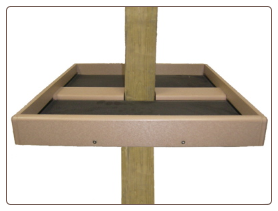
 I just don’t get it sometimes, because every year I promise myself to install seed catchers underneath my feeders, and every year I just clean up the mess below instead! For someone who does the backyard birding thing to the degree of overkill, you’d think these seed catchers would already be in place? Right now there are three heated birdbaths, ten in all! Feeding sunflower, thistle, suet, finch mix, live mealworms, peanuts, and oh…let’s not forget the squirrels! In summer we have two water wigglers, 2 misters and two birdbath drippers going too. By the way, the birds and butterflies really love the leaf misters!
Beside the unsightly mess below feeders, old seed becomes molded and poses a health hazard to the immediate bird population. Spreading fungus and airborne diseases is never good.The added platform space from a seed catcher virtually creates an additional feeder for birds who may not perch at the main feeder.
Available for 4×4 posts, standard 1-inch diameter poles, and adjustable hanging seed catchers, there’s just no more excuses for accumulated ground mess.

-
Offer nesting materials early to further entice birds
 Encourage birds to nest in your yard by offering them a good variety of nesting materials. Simple things you may likely already have around your home are fantastic, items which birds will use for nest building.
Got a pet? Cat and dog hair are some favorites, as are feathers, and decorative mosses. Spanish moss, sphagnum moss, raffia and aspen fiber are perfect nesting materials birds will go for! Brightly colored cotton yarns add to the mixture also helps grab their attention. One of the tricks is to have your nesting materials out before the nesting season begins, and in plain view where birds will easily see them.
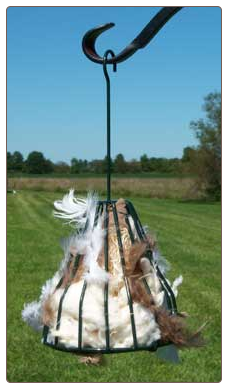
Lots of kits and fun holders are available for wild bird nesting materials. The Birdie Bell shown here actually does triple duty. It will hold fruit in summer for the more exotic, migratory birds, and seed bells or suet in winter to help sustain your regular crew. Come spring, simply fill the bell with nesting material. An item like this with year round usage is a good value. But truth be told… you can use a simple suet cage to offer nesting materials as well. Even the mesh produce bags from the grocery store (like the kind apples come in) will effectively hold nesting materials that birds can access.
So aside from the birdhouses and feeders, be sure there is a fresh water source too. Be it a creek or bird bath, all species of wild birds are drawn to water. And don’t forget: start gathering materials now that will entice feathered friends to take up residence! Happy Birding!
-
2011 Great Backyard Bird Count!
Great Backyard Bird Count Asks for Your Help
Count Birds February 18-21
Black-crested Titmouse. Photo by GBBC participant Gregg Lee, Texas.
February 8, 2011—The 14th annual Great Backyard Bird Count is coming up February 18–21, 2011. People of all ages and skill levels are needed to count birds in their yards, neighborhoods, or other locations across the United States and Canada. Simply tally birds for at least 15 minutes on any day of the count, then go to www.birdcount.org and enter the highest number of each species seen at any one time.
Coordinated by the Cornell Lab of Ornithology, Audubon, and Bird Studies Canada, the count provides an instantaneous snapshot of birdlife across the continent for all to see. Anyone can watch as the tallies come in at www.birdcount.org. Organizers hope to receive more than 100,000 checklists during the event, with tallies of more than 600 bird species in all.
Last year’s participants reported more than 1.8 million American Robins, as well as rarities such as the first Red-billed Tropicbird in the count’s history.
“Whether people observe birds in backyards, parks, or wilderness areas, the Great Backyard Bird Count is an opportunity to share their results at www.birdcount.org,” said Judy Braus, Audubon’s vice president of Education and Centers. “It’s fun and rewarding for people of all ages and skill levels–and it gets people outside!”
“When thousands of people all tell us what they’re seeing, we can detect changes in birds’ numbers and locations from year to year,” said Dr. Janis Dickinson, director of Citizen Science at the Cornell Lab of Ornithology.
“While this is the depths of winter in most of Canada and only the hardiest birds brave the cold, understanding of trends in the distribution and abundance at this time of year is important as well,” said Dr. George Finney, president of Bird Studies Canada.

A young GBBC participant carefully makes out her checklist. Photo by GBBC participant Christina Phinney, Michigan. Data from the Great Backyard Bird Count can provide an early signal of changes in bird populations. Past counts showed a drop in reports of American Crows after outbreaks of West Nile virus in 2003, a finding consistent with studies showing crow populations declined by 50–75% in some states. Maps from the count have also captured the paths of migrating Sandhill Cranes and recorded the dramatic spread Eurasian Collared-Doves. Introduced to the Bahamas in the 1970s, the species was reported in just 8 states during the 1999 GBBC. A decade later, it was reported in 39 states and Canadian provinces.
“I have joined the Great Backyard Bird Count for the past three years and am really looking forward to doing it again,” said participant Kathy Bucher of Exira, Iowa. “I really enjoy nature and bird watching. My mother and I share updates on the birds we see. It’s a fun hobby to share with a loved one!”
For more information, including bird-ID tips, instructions, and past results, visit www.birdcount.org. The count also includes a photo contest and a prize drawing for participants who enter their bird checklists online.

Birding Tips, Information & News