-
Eco Hummingbird Feeders for Earth Day Give-Away!
 There’s some awesome eco-friendly birdhouses and feeders out there, and with vibrant colors and fun designs-they’re made to last!
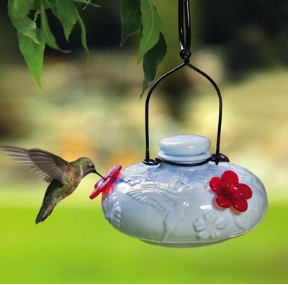
To help celebrate and honor Earth Day (which should really be everyday), our friends over at A Lucky Ladybug are giving away one of our recycled art glass hummingbird feeders. Since somebody has to win… it’s definitely worth a shot entering!
 The contest starts on Earth Day, Tuesday 22nd.
Do you have yours out yet? It’s time, it’s time! Because once again spring is late, many of the flowers hummingbirds naturally feed from aren’t yet available, nor are the insects on which they feast. After such a long journey over the gulf, the tiny sprites are hungry and tired… they need food to re-fuel for the continued journey North.
Here’s the Ruby-Throated migration status according to sightings reported to hummingbirds.net… see? It’s time!

If you start seeing hummingbirds and then you don’t, they may already be nesting, regardless of weather. Mother Nature gives them some serious hard wiring. For example, that crazy fighting over feeders-even when there’s plenty for everybody. It’s not just territorial. Their survival instincts are so strong, that claiming a particular hummingbird feeder is actually a matter of life or death for them!
So get your feeders out of storage and first give them a good cleaning. Warm soapy water and a thorough rinse does the trick. Mix up a batch of nectar (consider making your own this year-it’s so simple). The solution can be made a bit stronger during migration periods as extra calories are helpful… especially when natural food sources are scarce. With smaller feeders, be sure to watch nectar levels so they don’t run dry, and do keep nectar fresh, changing it every few days. If hummingbirds come across spoiled nectar… they may not return to that feeder later.
Oh yeah, and don’t forget to head on over to A Lucky Ladybug on Earth Day (Tuesday, 4/22) and enter the Give-Away! This 16-ounce capacity glass hummingbird feeder, complete with red Parasol ant moat and nectar could be yours… for many seasons of use by tiny sprites!
-
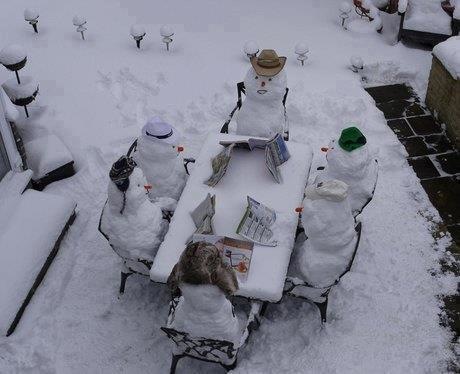
Can You Spot the Thistle Feeders?
 Me neither as they must be covered in snow and awaiting the big thaw. So this is April? Wisconsin, Minnesota, somewhere like that. Goldfinches are already shedding worn winter feathers and turning yellow, while other common resident birds are nesting in much of the country. Once again, will winter ever end?
Yesterday brought our first butterfly to the yard, but unfortunately the consecutive, way below normal night temperature this year zapped established lantana that was seven years old. You could always count on butterflies around those shrubs. Yes, that’s how big they were, mature shrubs.
Erratic weather is largely attributed to climate change, but many folks don’t see it that way. Mudslides, volcanoes, drought and rising sea levels to name a few effects are pretty apparent and scarily becoming the norm.
In the bluebird world, trail monitors found a record number of dead bluebirds in the KY area. A very late spring being the culprit after such a rough winter… there were simply no natural food sources available. Someone was inquiring about a feeder the other day and said “no rush, it’s for next year, we don’t really feed birds in summer”. We’ve come across many folks like that, but here’s the reality: weather directly affects food sources and bird’s survival rates.
Last summer through a wicked drought, we witnessed a male cardinal feeding a fledgeling from a platform feeder containing
 sunflower hearts. From ground to platform and back he flew feeding his offspring. It was a strange sight, as others were reported this winter too. Cardinals hanging on suet feeders, and ground-feeding juncos up at black oil feeders. Many of the migratory birds were in for a harsh surprise upon arrival into the gulf states. No flowers, no berries, no insects, simply an equation for starvation after a long journey like that.
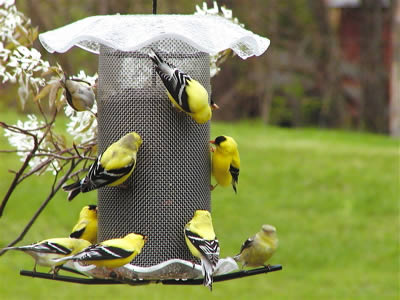
Closer to home, resident birds braved a very tough season as well. Feeders were non-stop with activity for the most part. Although thistle feeders didn’t see too much traffic, other feeders containing finch mixes did… and a lot! Once the olive drab fliers began their molting process, straight nyjer became goldfinches’ food of choice and overnight, thistle was and is being devoured daily!
The good news is this seed has come down in price a little bit, and if you can manage the larger bags, like 20-to 40-pounders, you’ll save even more money this summer. Unlike other birds, goldfinches feed nestlings and fledgelings thistle-almost exclusively.
So if you’re not really a “summer feeder”, you may want to rethink maybe just one or two feeders this summer… the bird families sure will thank you!
-
Bird Brain Hummingbird Feeders for Citizen Science
 Audubon Invites Volunteers to Help Track Hummingbirds This Spring
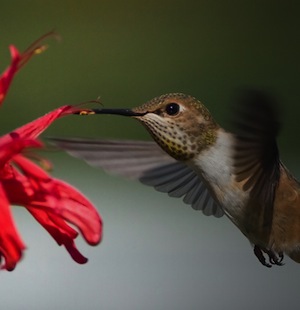
Take your hummingbird feeders a step further by helping Audubon track the tiny sprites this season. All habitats and feeders are welcome; from the old bird brain hummingbird feeders to honeysuckle and trumpet vine to colorful annuals providing food…. watch near fountains too, another favorite of this flying jewel!
NEW YORK, NY (April 1, 2014) – With spring officially upon us, the National Audubon Society invites birders and nature enthusiasts across the country to help track the health of hummingbird populations with Audubon’s Hummingbirds at Home app. This citizen science project utilizes the power of volunteers to compile data at a scale that scientists could never accomplish alone.
Every spring, numerous hummingbirds migrate long distances and must eat several times their weight in nectar daily to stay alive. Hummingbirds visit our yards every year, looking for nectar from our gardens and feeders. As flowers bloom earlier because of warming temperatures, the impact on hummingbirds which rely on nectar could be significant. The degree to which hummingbirds are able to adapt to accommodate these changes is not completely understood. Hummingbirds at Home was designed to bolster current research by collecting data from volunteers across the country that offers important insight on the effects of climate change and the birds’ well-being.
“Increasingly people are seeing the impact of climate change in their own backyards, from early blossoms to extreme weather,” said Dr. Gary Langham, Chief Scientist at Audubon. “This is a fun, family-friendly citizen science project that works in the classroom or in the kitchen.”

Hummingbirds at Home differs from other bird monitoring programs in that the focus is on recording the species, nectar sources, and feeding behavior observed. In the case of bloom timing mismatches, Audubon hopes to eventually learn if alternate nectar sources, like feeders, make a difference in hummingbird breeding success and survival.
Participants can get involved by spending a few minutes as frequently as they wish to collect invaluable data from feeding areas in their gardens and communities. Audubon’s Hummingbird at Home app makes it fun and easy. There is no cost to participate and using the free mobile app or website makes it simple to report sightings and learn more about these remarkable birds. For more information visit, www.hummingbirdsathome.org.
About Audubon
The National Audubon Society saves birds and their habitats throughout the Americas using science, advocacy, education and on-the-ground conservation. Audubon’s state programs, nature centers, chapters and partners have an unparalleled wingspan that reaches millions of people each year to inform, inspire and unite diverse communities in conservation action. Since 1905, Audubon’s vision has been a world in which people and wildlife thrive. Audubon is a nonprofit conservation organization. Learn more at www.audubon.org and @audubonsociety.

Birding Tips, Information & News