- Bird Accessories, Bird Bath, Bird Baths, Birdbaths, Heated Bird Bath, Pedestal Bird Bath, Uncategorized
Quick Preparations are like a face lift for bird baths
 Georgia weather can be so finicky, we usually get cheated out of any decent spring and fall weather. With the last few days in the 70’s and nights around 50 degrees, a cold snap is headed our way. Predicted low temperatures are below freezing starting tomorrow night, until of course, we are back in the 70’s again next week.
There are several bird baths in the yard, (no – make that too many bird baths in the yard) that won’t fare well in freezing temperatures. The concrete pedestal bath for one, along with the ceramic pedestal bath will definitely crack. The plastic ground bath with the dripper will do the same.
I never really understood how folks could just dump the water and turn their bird baths over for winter? Fresh water is a critical element for birds’ winter survival. When temperatures drop below freezing, most shallow pools and ponds tend to freeze, leaving many wild birds no immediate water source.
In lieu of the nearing cold snap, tomorrow’s chores include winter preparations for feathered friends, almost a bird bath face lift if you will. Removing summer bath
 accessories like water wigglers (shown above) and drippers like this one, and adding heaters to the baths will keep birds flocking and happy! The deck-mounted bath conceals its heater inside, so it just needs to be plugged in…yay!
Adding heaters to your existing bird baths is one of the best ways to keep birds around. Last year our Eastern Bluebirds over-wintered, staying around through one of the nastiest winters on record.
Help feathered friends to thrive and flourish during frigid winter weather by creating a wildlife-friendly habitat with a consistent fresh water source, food and shelter.
-
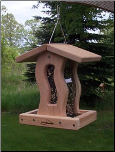
Sculptural Hopper Bird Feeders
 A Very Hip Hopper Bird Feeder!
Hand crafted in cedar and stainless steel, and definitely built for the birds, these hopper bird feeders are unique in design and quality. It’s just one of a series of the “Wave Feeders”. The free-form, sculptural design adds elegance and makes for a great conversation too.
Functional art for the garden like this enhances the environment, while helping feathered friends thrive and flourish. The handcrafted quality is unsurpassed, with polycarbonate windows that will not yellow over time. They’re virtually indestructible, ensuring many seasons of use and enjoyment. Holding three pounds of black oil, or any seed mix, hopper bird feeders like these make awesome, and long lasting gifts that will really be used and admired…by the recipient and their feathered friends alike!
-
No Halloween Treat for Bats
For Immediate Release, October 27, 2010
National Plan for Bat-killing Disease
Too Little, Too LateRICHMOND, Vt.— Four years into a wildlife disease epidemic that has already killed more than a million bats in the eastern United States, the federal government today finally released a national response plan for white-nose syndrome. But the U.S. Fish and Wildlife Service’s plan is still only in draft form and only provides a conceptual framework for responding to the disease. It lists no specific action items and makes no concrete recommendations for research and management of the fast-spreading malady that has hit nine bat species so far, including two on the endangered species list.
“It’s frightening to watch the government’s slow-motion response to what biologists call one of the worst wildlife declines in American history,” said Mollie Matteson, conservation advocate for the Center for Biological Diversity. “A year after it first released a draft version of its plan, we have yet another draft, and nothing that actually gives direction or provides resources to scientists in the lab or biologists in the field.”
White-nose syndrome is associated with a newly identified fungal species that grows on bats’ noses and wings and causes them to die of starvation during the winter. From its epicenter near Albany, NY, the disease has spread rapidly, with the fungus now found on bats in 14 states, from New Hampshire to Oklahoma, as well as the Canadian provinces of Quebec and Ontario. Bats play a vital role around the country in controlling moths, beetles and other insects.
“What would Halloween be without bats? Scarier still, what would America be without them?” Matteson said. “If we’re going to stem the spread of this deadly disease, we need the government to move quickly with a well-coordinated, well-funded response. In moving too slowly and failing to include concrete action, this plan keeps bats on the path to extinction, and we’ll all be poorer for it.”
The national plan has been long awaited by wildlife agencies and conservation groups as a way to push response to the disease into higher gear. Already, some bat populations in eastern states have declined by as much as 80 to 100 percent, and scientists fear that as the disease spreads westward, it will eliminate entire species of the insect-eating mammals. Insect populations may take off as a result, biologists say.
“The nightmare of this disease is only accelerating, but the federal government continues to waste time, as if it has decades to figure things out. The bats can’t tolerate more dramatic losses, and they can’t tolerate any more government foot-dragging,” said Matteson.
As an alternative to the Fish and Wildlife Service’s conceptual draft plan, the Center for Biological Diversity is urging the federal government take the following actions over the coming several months:
- Immediately declare white-nose syndrome a wildlife emergency
- Dedicate at least $10 million for white-nose syndrome research in next year’s Interior budget
- Develop a systematic plan for restricting access to all bat-occupied caves and mines on Bureau of Land Management lands and prohibit nonessential human access to all U.S. Forest Service caves in the Southwest by the end of the year
- Finalize the national response plan for the disease by mid-January
- Develop a National Park Service plan by mid-February to limit the disease’s spread
- Prohibit nonessential human access to all Forest Service caves in the Intermountain, Northern, Pacific Southwest and Pacific Northwest regions by late February
The Fish and Wildlife Service is accepting public comments on the draft plan for the next 60 days. After that, it will review the public response and finalize the plan. Specific measures for addressing the bat disease will be contained in a subsequent implementation plan, but there is no deadline for completion of the implementation plan, according to Fish and Wildlife Service officials.
Background
The Center filed a petition earlier this year to close all federally owned bat caves in the lower 48 states to protect bats from the possible human-caused spread of the white-nose fungus. Since then, the Forest Service has declared all bat caves in its Rocky Mountain Region (Kansas, Nebraska, Colorado and most of Wyoming and South Dakota) off-limits to recreational use; the Bureau of Land Management advised its state directors to take precautionary measures against the disease, including targeted cave closures; and the Fish and Wildlife Service administratively closed all bat caves and mines within the national wildlife refuge system. Last year, the Forest Service closed bat caves to recreational use in eastern and southern national forests.The Fish and Wildlife Service has yet to act on a Center petition, filed last January, to list two white-nose-affected bat species under the federal Endangered Species Act, despite clear evidence that bat numbers have declined dramatically in the East, where white-nose syndrome has been present the longest.
To learn more about bats and white-nose syndrome — and to see an animated map of the disease’s spread — go to
http://www.biologicaldiversity.org/campaigns/bat_crisis_white-nose_syndrome/index.html.

Birding Tips, Information & News