-
Landmark Victory in Federal Court for IDA
In Defense of Animals Wins Landmark FOIA Victory in Federal Court
USDA Forced to Disclose Records from Controversial Animal Test Lab Huntingdon Life Sciences
Washington, DC —After a seven-year court fight, including the first trial in years involving the federal Freedom of Information Act (FOIA), the U.S. Department of Agriculture has been ordered by a federal judge to disclose 1,017 pages of records obtained during an investigation of controversial toxicology lab Huntingdon Life Sciences (HLS) to In Defense of Animals, the animal protection group said today.
“These records will shed light on the USDA’s failure to enforce the Animal Welfare Act,” said IDA Research Director Eric Kleiman. “Why did the USDA, later joined by HLS, fight so hard and so long to prevent the public from seeing these records? We’ll know within the 60 days ordered by the Court.”
The records – 503 pages withheld in full, 514 withheld in part (with most heavily redacted) – include test results, notes of observations of primates involved in toxicology testing, Animal Care and Use Committee minutes as well as necropsy reports and requests for veterinary care from six studies.
IDA filed the lawsuit in 2002 against the USDA, but later HLS “intervened” and also became a defendant. At trial, the USDA did not produce a single witness; HLS had two.
The December 2008 trial, the first in years involving FOIA, resolved the issue of whether HLS would suffer competitive harm if the records were disclosed. These records, obtained by the USDA during its investigation of the lab, formed the basis of the USDA’s formal complaint against HLS, alleging multiple and grave violations of the Animal Welfare Act (AWA). The charges included multiple counts of failing to provide adequate veterinary care and inadequate research oversight.
Within days of filing the complaint against HLS, the USDA settled it with what IDA termed a “slap-on-the-wrist” fine. This was consistent with multiple USDA Inspector General reports regarding the agency’s lax enforcement of the AWA. The most recent, in 2005, stated that USDA imposes “minimal” fines that “violators consider…a normal cost of conducting business rather than a deterrent for violating the law.”
The FOIA trial came about as a result of an opinion by another judge, who, after reviewing a sampling of the unredacted records in camera (in private), expressed his doubt that defendants could prevail at a trial focusing on the issue of competitive harm. This judge stated that the USDA and HLS came “mighty close” to “’blatantly’ contradicting the record” in the case. He also noted that the USDA had violated a prior court order by failing to produce an analysis of what could be redacted from the records.
Kleiman noted that IDA has won multiple FOIA victories, including a court-ordered public interest fee waiver for thousands of pages of NIH records after IDA had proven its “dissemination methods and history demonstrate that the disclosure will contribute to a greater understanding” by the public. IDA has also used FOIA records to document data manipulation and researcher misconduct (see “Drug Study Hid Chimp Deaths,” at http://www.startribune.com/templates/Print_This_Story?sid=11617276
“This victory is the latest in a long line of IDA campaigns that often take years,” concluded Kleiman. “No matter how long, IDA will continue to persevere on behalf of those who cannot speak for themselves.”The public interest law firm Meyer, Glitzenstein & Crystal represents IDA in this case. The District Court opinion is available online at https://ecf.dcd.uscourts.gov/cgi-bin/show_public_doc?2002cv0557-121 <file://localhost/cgi-bin/show_public_doc>
In Defense of Animals is an international animal protection organization located in San Rafael, Calif. dedicated to protecting animals’ rights, welfare, and habitat through education, outreach, and our hands-on rescue facilities in Mumbai, India, Cameroon, Africa, and rural Mississippi.
___________________________________________________________________________________________________________________
IN DEFENSE OF ANIMALS · 3010 KERNER BLVD. · SAN RAFAEL, CA 94901 · 415-448-0048
-
Why Clean Wild Bird Feeders?

In the natural world it’s “survival of the fittest” or “natural selection” which keeps species healthy and flourishing. When we feed wild birds, there is an unnatural gathering that takes place. Mind you, backyard birding is one of the most popular and relaxing hobbies today, and providing food and shelter for birds is a wonderful way to help them thrive.
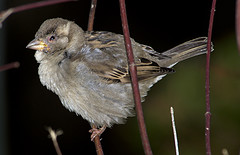
With our wild bird feeders, most of us don’t take the necessary precautions to prevent the spread of diseases. Aside from the regular molds and fungus that can make birds sick, they can develop viral infections as well. These infections are easily spread at high-activity feeders, and carried to other feeders as well. This little sparrow has conjunctivitis, a disease affecting the eye, causing irritation and swelling at first. Blindness usually follows, and soon death as the bird can not venture far to find food. They say if you see a sick bird like this at your feeders, it’s best to stop feeding, as you’ll decrease, or possibly avoid any further spread of the disease. It’s a rare occurrence for a bird to fully recover from a disease like this.
The most effective and practical cleaning solution is bleach! Simply mix 1 part bleach to 10 parts water. Scrub with a brush and rinse thoroughly. At the very least, shoot for once a month. Your birds will be healthier and thank you for it!
- Bird Accessories, Bird Feeders, Fly Thru Bird Feeders, Hopper Bird Feeder, Recycled Bird Feeders, Uncategorized, Wild Bird Feeders
Have You Tried Recycled Wild Bird Feeders?


They’re guaranteed to never crack, split, or fade!
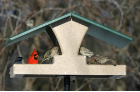
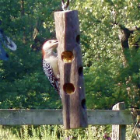
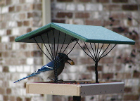
If you could purchase something that came with a manufacturer’s guarantee, wouldn’t you trust it? Recycled wild bird feeders are probably one of the greatest advancements in backyard birding products. Made from milk jugs and other recycled plastics, they greatly reduce landfill waste, and are some of the most durable feeders on the market! The Log Bird Feeder above uses 10 milk jugs for it’s production, while the Fly-Thru Feeder uses about 32 milk jugs each!
Most recycled feeders are guaranteed to never crack, split or fade. Attractive as well, they’re available in every style from hoppers, to platforms and fly-thrus, and even log feeders for feeding suet to woodpeckers and others. Recycle and Reuse!


Birding Tips, Information & News