-
Plight of Famed Wild Horses and BLM
Latest Victims of BLM Roundups:
Family of Cloud, Wild Horse of PBS Fame,
Dumped at Federal Auction Saturday
Lovell, WY (September 24, 2009) — This weekend, the Bureau of Land Management (BLM) will auction the offspring of the much-celebrated Cloud herd of wild mustangs, captured earlier this month, along with other horse bands, from the Pryor Mountain Wild Horse Range that borders Wyoming and Montana. In Defense of Animals (IDA), an international animal protection organization, is outraged at this latest travesty committed by the BLM, a division of the U.S. Department of Interior and the government agency entrusted to protect wild horses. A popular PBS Nature series, which has chronicled the story of the near-mythical wild stallion Cloud and his family, has brought into the public consciousness the plight of America’s wild horses. Wild horses have always been fixed in people’s minds as the embodiment of true and unfettered freedom.“Just two weeks ago, the majestic horses of Pryor Mountain were living wild and free with their families,” said IDA President Elliot M. Katz, DVM. “Now those families have been shattered forever. 57 of these beloved horses are imprisoned in BLM holding pens awaiting an uncertain future. If the world’s most famous herd cannot be saved, then the future looks bleak for the wild mustangs who are part of our nation’s heritage.”
The auction of Cloud’s family members on Saturday comes just two days before the BLM’s National Wild Horse and Burro Advisory Board will hear public dissent over the government’s inhumane wild horse management program, which plans to round up thousands more wild mustangs, even as an astounding 33,000 horses are currently warehoused in government facilities at a cost to taxpayers of $100,000 per day and tens of millions annually.
An IDA observer documented the Pryor Mountain herd roundup, in which horses, including young foals, were mercilessly chased by helicopter causing injuries and lameness. In addition to members of Cloud’s family, four other bands of horses were rounded up from the Pryor Range, including older horses like Conquistador, a 19-year-old stallion and his 21-year-old mare.
“The inhumanity of the BLM’s policy is most evident in the roundup and auction of the older horses who are completely unsuitable for adoption. These horses have no future unless returned to the open range immediately,” Katz continued.
The Pryor Mountain horse roundup is just one of many BLM captures underway; in late August, the agency began roundups southwest of Ely, Nevada, intending to capture and remove more than 600 horses from 1.4 million acres of public lands.
At Monday’s public hearing, scheduled from 8 a.m. to 5 p.m. (public testimony at 3 p.m.), at the Hyatt in Arlington, Virginia, IDA will call upon the Obama Administration to reverse the BLM’s scandalous wild horse policy, which aims to remove thousands of additional horses from public lands while continuing to allow millions of privately owned cattle to graze those same public lands.
IDA is also supporting passage of the Restoring Our American Mustangs Act (ROAM), which would update existing laws that protect wild horses by prohibiting the killing of healthy wild horses and burros, removing restrictions on areas where horses can roam freely, and facilitating the establishment of wild horse sanctuaries, among other provisions. This summer. ROAM was passed by the House of Representatives on a 239-185 vote and is currently in the Senate’s Energy and Natural Resources Committee. When Congress unanimously passed the Wild Free-Roaming Horses and Burro Act of 1971, these wondrous mustangs were described as “the living symbols of the historic and pioneer spirit of the West.” The horses who remain deserve our fierce protection.
# # #
In Defense of Animals is an international animal protection organization located in San Rafael, Calif. dedicated to protecting animals’ rights, welfare, and habitat through education, outreach, and our hands-on rescue facilities in Mumbai, India, Cameroon, Africa, and rural Mississippi.
___________________________________________________________________________________________________________________
IN DEFENSE OF ANIMALS · 3010 KERNER BLVD. · SAN RAFAEL, CA 94901 · 415-448-0048Pli - Bird Accessories, Bird Feeders, Glass Bird Feeder, Tube Bird Feeder, Uncategorized, Wild Bird Feeders
Tube Birdfeeders for Growing Grass?
 Recently we’ve had lots of rain here in Georgia, which is great because we’re usually in a drought. However, I think this past episode may have been one of those “500-year” occurrences!
Inundated, with rain, it has not let up for days, then the grand finale…about 16 inches in 24 hrs. All of the feeders were soggy, soaked, and stinky! Not once, but twice, the tube birdfeeders were dumped and cleaned. The seed became packed down, and downright nasty. There was grass growing in them!
The sideways rain had turned the little sanctuary into a health and safety issue for feathered friends.
With 2000% humidity, waiting until the storm passed,would likely have been a better option!
-
Why Clean Wild Bird Feeders?

In the natural world it’s “survival of the fittest” or “natural selection” which keeps species healthy and flourishing. When we feed wild birds, there is an unnatural gathering that takes place. Mind you, backyard birding is one of the most popular and relaxing hobbies today, and providing food and shelter for birds is a wonderful way to help them thrive.
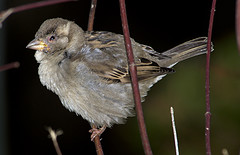
With our wild bird feeders, most of us don’t take the necessary precautions to prevent the spread of diseases. Aside from the regular molds and fungus that can make birds sick, they can develop viral infections as well. These infections are easily spread at high-activity feeders, and carried to other feeders as well. This little sparrow has conjunctivitis, a disease affecting the eye, causing irritation and swelling at first. Blindness usually follows, and soon death as the bird can not venture far to find food. They say if you see a sick bird like this at your feeders, it’s best to stop feeding, as you’ll decrease, or possibly avoid any further spread of the disease. It’s a rare occurrence for a bird to fully recover from a disease like this.
The most effective and practical cleaning solution is bleach! Simply mix 1 part bleach to 10 parts water. Scrub with a brush and rinse thoroughly. At the very least, shoot for once a month. Your birds will be healthier and thank you for it!

Birding Tips, Information & News
 Recently we’ve had lots of rain here in Georgia, which is great because we’re usually in a drought. However, I think this past episode may have been one of those “500-year” occurrences!