-
They’re Scouting Bluebird Houses Already!
 Despite adverse conditions of the polar vortex and another extreme winter, bluebirds and others are on the move, searching for suitable digs to raise their young. Even though snow is covering most of the country, Mother Nature’s biological clock tells them it’s time, the calendar and number of daylight hours is what lets them know.
Early migrating birds on the Atlantic Flyway like swallows, warblers and flycatchers rely on insects as they island hop through the Caribbean onto Cuba. When making landfall along the gulf states, their usual smorgasbord of insects, flowers, fruits and berries will be be scarce. Many neo-tropicals, including hummingbirds run the risk of depleting fat reserves before they reach spring breeding grounds here in the US. Simply put, if you think the weather has been an inconvenience – it makes life miserable for wildlife as well, and many birds just won’t make it 🙁
Closer to home, over-wintering residents like bluebirds are already checking bluebird houses to claim for nesting and raising their broods. With snow on the ground and high temperatures right at freezing, you can hear birds belting out their breeding songs! If there was a way to say “wait… it’s still too cold!” we most certainly would-but then again, man is no force against nature.

Best we can do is help feathered friends along the way by offering fresh water, food, and birdhouses that are ready for nesting. If you haven’t done so already, please check your bluebird houses and remove old nests. Be sure they are secure, sturdy and ready for vacancy. If you can stomach it, live mealworms are their favorite, but suet, peanuts and sunflower hearts also offer much needed fat and proteins.
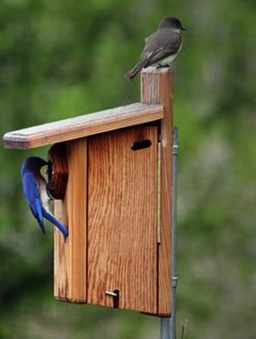
An Eastern Phoebe perches atop this bluebird house while the male checks out its interior. Phoebes won’t use these houses, but may take up residence in barn swallow nest cups if you offer them in sheltered areas around your home.
During this treacherous weather… please help birds and wildlife with supplemental feeding and a heated water source… thanks on behalf of the birds 🙂
-
The Nastiest Squirrel Baffle Ever
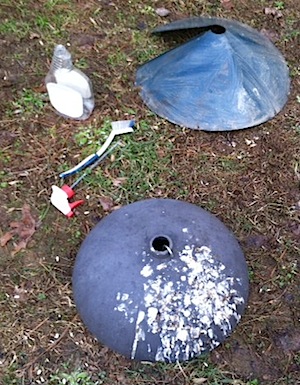
 What a blasted mess, and they were just cleaned a few weeks ago too!
Starlings, European starlings have got to be the most annoying, nastiest bird in our yard. It’s usually temporary and then they move on. But sure as day if they start nesting around here, a scope will be a near-future purchase! Yes, it’s legal to shoot them, aggressive, invasive and non-native, they wreak havoc on native nesting birds like bluebirds, tree swallows and purple martins. Not to mention, they make the worst mess and hog all the food too. Like magicians, a tray full of mealworms can disappear in no time flat!
These baffles were just removed and cleaned not long ago. Starting with pole-mount squirrel baffle (at top) the picture was snapped before cleaning the hanging one. Why? Because there was a post on a social site glorifying starlings! Huh, are you kidding me? How could anyone possibly favor this bird? Is that not one of the filthiest things you’ve ever seen?
Using a squirrel baffle won’t stop starlings, but it sure does stop squirrels if used properly. If a feeder is hanging from a pole or shepherd’s hook, the pole-mount ones work best. They’ll keep squirrels from shimmying up the pole, but the bottom of the baffle must be at least must be at least 4.5 feet from the ground. Otherwise, they’ll jump right passed it. These wrap-around styles are perfect if there’s a ground stake at bottom, or decorative piece at top. Smart, smart design!
If your bird feeder hangs from a branch, then a hanging baffle would be appropriate. It blocks squirrel’s from climbing down onto the feeder from above. Feeder placement however should be at east 8 feet away from anything squirrels might jump from (sideways) to gain feeder access. The bottom of the actual feeder should also be at least 4.5 feet from the ground.
These general specs usually work well… unless you happen to host the occasional uber-squirrel! Feeder and baffle placement may then require some tweaking to avoid the critter’s shenanigans in full! As far as the starlings? They do make traps for these pesky birds… but you’re on your own. Actually the website Sialis.org gives some great examples on starling and house sparrow control if you’re hosting native cavity nesters in your yard.
Be gone dreaded starlings and come on spring!
-
Got Your Nyjer Feeder Ready?
 Goldfinches are back in droves.. but they’re not quite so gold yet. Still sporting drab winter plumage, it’s not until late spring/early summer when they’ll molt again. It’s the process of shedding old worn feathers to make way for new ones, and goldfinches happen to be one of very few birds who molt twice per year.

If your nyjer feeder has been sitting for a while sans activity, the older seed may be moldy, and finches won’t eat it. Consider trashing that old seed, giving the feeder a good cleaning and refilling with fresh goods. Doing this provides a welcome sign for these cool little birds.
One of the larger capacity feeders is shown here – holding 5+ lbs. of seed. A relative of the Rainbow Finch Feeder, the Super version is even better for large finch crowds. With colorful perches and a great design, this nyjer feeder lets you fill from both the top and bottom. This eliminates stale seed piling up at the bottom. By alternating which end is filled with fresh seed, there’s never a build-up of old stuff.
There’s another bird out there now who might easily be confused with the goldfinch. About the same size, but very opposite behavior, warblers can be pretty territorial around bird feeders. Males will fight and fend off others, doing this sort of vertical flight dance where the birds look almost intertwined. Goldfinches on the other hand would rather find another feeder than fight.
 This is when an extra thistle sock or two come in very handy. Inexpensive and simple to use, they offer extra feeding spots during goldfinches’ busy breeding season. Oh and this warbler… he’s got a mouthful of suet and a big attitude too!
To roll out the welcome mat for finches and other songbirds, offer a consistent fresh water source and keep bird feeders clean. Adding some nesting materials in early spring will also encourage residency at your place!


Birding Tips, Information & News