-
The Big Meow Project Tackles Overpopulation in CA
THE BIG MEOW IS A BIG HELP FOR YOUR WALLET AND CAT OVERPOPULATION
SEAACA & Pet-Connections to Provide No-Cost Spay & Neuter Programs for Owned Free-Roaming Cats(LOS ANGELES, CA) August 11, 2011 – SEAACA (Southeast Area Animal Control Authority; www.seaaca.org) and Pet-Connections are helping cat owners who live in the 14 cities served by SEAACA with the BIG MEOW, a compelling program to provide no-cost spay and neuter serviced for owned free-roaming cats. The year long, national program kicks off at SEAACA on August 17 with photo opportunities during cat drop-off (7:15 a.m. to 8:45 a.m.) and pick-up (2:00 p.m. to 4:00 p.m.).
SEAACA and Pet-Connections will offer a variety of services for owned free-roaming cats at absolutely no cost to cat owners. Services include spay or neuter, microchip ID (so cats have permanent ID in addition to a collar), vaccines (FVRCP and rabies), one month application of flea and tick control and basic health care at the time of surgery.
The BIG MEOW is a significant step in improving cat health and curtailing overpopulation. Spayed or neutered cats tend to want to stay inside with their families. Cats that roam, however, can get lost, hit by passing cars, be exposed to pesticides, poisons or unhealthy plants and disturb neighbors. Moreover, an un-spayed female cat, her mate and all of their offspring, producing two litters per year, with 2.8 surviving kittens per litter, can result in thousands of cats (over 2,000 cats in four years and over 370,000 cats in seven years!).
“The BIG MEOW delivers monumental benefits for everyone,” noted SEAACA Executive Director, Dan Morrison. “It helps owned free-roaming cats lead safer, healthier lives. It also helps manage the surplus cat problem, and the no-cost element helps personal finances in tough economic times,” he added. The Big Meow will result in over 50 surgeries at SEAACA on the “kick-off day” (August 17) with partner veterinarians in private practice performing another 100 to 150 surgeries on that day; the annual goal for SEAACA is 3,000 surgeries. The Inland Valley Humane Society is concurrently doing the same program.
In order to participate in the BIG MEOW, cats must be four months to seven years of age. Only owned free-roaming cats are eligible (no feral or wild cats will be accepted). Additionally, cat owners must provide proof of residency in SEAACA service cities and each cat must be in a properly secured kennel or carrier.
For more information about the BIG MEOW or SEAACA, please visit www.seaaca.org, or call the appointment line at 562-803-3301 ext. 251.
About SEAACA
SEAACA (Southeast Area Animal Control Authority) provides animal care and control services for 14 cities in southeast Los Angeles County and northern Orange County, including Bell Gardens, Bellflower, Buena Park, Downey, Lakewood, La Palma, Montebello, Norwalk, Paramount, Pico Rivera, Santa Fe Springs, South El Monte, South Gate and Vernon. SEAACA’s Animal Care Center located in Downey reunites pet owners with lost pets and assists new pet owners with pet adoptions. SEAACA’s Animal Wellness Clinic, also located in Downey, spays and neuters all adoption animals plus provides vaccinations and microchipping to the general public. For more information about SEAACA, please visitwww.seaaca.org.
About Pet-Connections
Pet Connections, Inc. is a national organization dedicated to developing coalitions between pet owners, community leaders and animal welfare organizations to reduce the number of stray and unwanted cats and dogs. -
un-square and un-boring hopper bird feeders
 With so many variations of bird feeders out there, how would you ever pick the right kind if you’re new to backyard birding? Aside from offering fresh water in a bath, choosing several feeders which hold different kinds of food is very effective for enticing feathered friends.
There are five basic types of wild bird feeders, although variations abound! Hopper Bird Feeders like this ceramic blue one also add a decorative touch to any garden or landscape.
Tube Feeders dispense seed and allow multiple small birds to feed at once. The ones with very tiny ports are designed for thistle or nyjer seed-which is a favorite of Goldfinches and Pine Siskins.
Hopper Bird Feeders are likely the most popular type of feeder as they attract a wide variety of birds and generally have larger seed capacities. They feature removable or lifting lids for easy filling and cleaning, and a ledge, or perching space to accommodate several birds.
Platform or Fly-Thru Feeders will attract the widest variety of birds, they’re versatile for offering several kinds of treats that you can change with seasons. One drawback to this type of feeder is is that seeds can become contaminated with droppings and may mold quicker with the right weather conditions. A fly-thru feeder’s roof has an advantage to protect seed from weather.
Nectar Feeders are meant for Hummingbirds and Orioles, and may be seasonal according to your location.
 We use them from mid-March through December in this North Georgia yard. Commercial nectar mixes are widely used, but we think the home-made sugar water solution is preferred.
Suet Feeders are usually a cage-type or bag feeder and should be protected from squirrels (and other pets). They’re great for offering fruit slices in summer, and nesting material in early spring. Many species covet suet for it’s high protein and fat content, especially during cold winter months. No-melt varieties of suet are also made for warm-weather feeding, as migratory birds also enjoy this special treat.
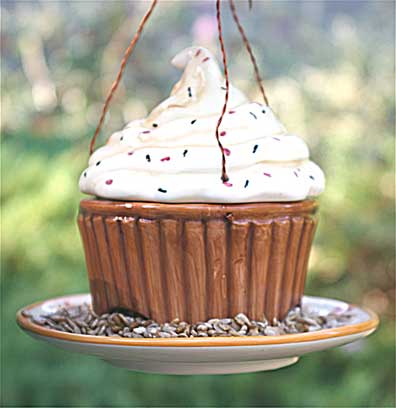
So that’s a basic run-down of wild bird feeders… although some may be more wild than others! This ceramic cupcake is also a variation of the popular hopper feeder.
-
ANIMAL RESCUERS DEFEND ONLINE PETITION IN COURT
Michigan court rules that petition to save three victims of animal cruelty can stay on Change.org
MONROE, MICHIGAN – A Monroe County judge has upheld the First Amendment rights of animal activists appealing for the lives of three dogs rescued from a dog fighting bust.
Advocates from the Monroe SPCA and Buster Foundation, a pit bull rescue group based in Belleville, Mich., posted photographs and videos of the dogs online to support their case that the animals should not be put down.
Jennifer Burke, a local animal advocate, started a petition on Change.org, the world’s fastest growing social change platform. The petition, which has gathered more than 4,000 signatures in less than three weeks, features a video of a dog named “Dusty” being evaluated by Dr. Katherine Houpt, the prosecution’s expert witness. The video makes the case that that Dr. Houpt’s testimony condemning the dog does not match the evidence.
“I created the petition because we were finally allowed to show the public what sweet, gentle dogs these are, and my opinion is that the expert was biased based on the testimony from her evaluations,” said Burke, the Change.org petition starter, in reference to the July 13th decision to put three of the four dogs down.
The Monroe County prosecutor wanted the groups held in contempt of court for distributing materials about the case online. But on August 4 Judge Vitale of the First District Court ruled that forcing the advocates to remove the photos and video from Change.org, their websites and social media would infringe on their First Amendment rights.
“This is about fighting for whats right, and we have 3800 signatures to prove that we are not alone,” said Burke, the Change.org petition starter. “We are aware that there are thousands of other dogs out there that need rescue, however if we continue to stand by and watch these needless killings we aren’t getting to the root of the problem. Michigan taxpayers have a right to know where their money is being spent.”
“We are shocked that the prosecution has made our battle for getting these dogs vet care, training, and human contact almost impossible,” Burke continued. “This is wrong, and we are standing up for ourselves and for these dogs that deserve a second chance. This victory means we are re-energized for our appeal. The community support has been amazing.”
“The dedication of Ms. Burke, the rescue groups and the community to giving these dogs a second chance is remarkable,” said Stephanie Feldstein, Senior Organizer for Change.org. “Through the petition on Change.org and their social media outreach, they’ve truly succeeded in giving these dogs a voice.”
The groups will gain custody of one dog, Razzle, later this month. The appeal to save the lives of Dusty and two other dogs has not yet been scheduled.
Live signature totals from the campaign on Change.org:
https://www.change.org/petitions/katherine-houpt-vmd-phd-recant-testimony

Birding Tips, Information & News