-
Victory for IDA and 2 Circus Elephants
IDA Applauds Federal Confiscation of Suffering
Circus ElephantsGroup has worked for two years to rescue Tina and Jewel; vows to continue fight for third elephant, Queenie
LEGGETT, TEXAS — August 20, 2009 — In Defense of Animals today hailed the federal government’s confiscation of two long-suffering circus elephants from their Texas-based handler, but vowed to continue to fight for the rescue of a third elephant who was left behind.IDA has been campaigning to rescue Tina, Jewel and Queenie for over two years, tracking their movements across the country, documenting their physical deterioration, filing multiple federal complaints regarding their illegal acquisition and negligent care, and mobilizing thousands of people across the country to contact federal agencies and Congress on the elephants’ behalf.
Tina and Jewel were confiscated today by the U.S. Department of Agriculture (USDA), with backup from the U.S. Fish and Wildlife Service, from their handler Will Davenport. Davenport has amassed a two-year record of chronic Animal Welfare Act violations, including failure to provide adequate veterinary care and negligent, unsafe and abusive handling practices. He also violated the U.S. Endangered Species Act in the illegal purchase of Tina and Jewel- highly endangered Asian elephants – from another circus.
“We are greatly relieved that Tina and Jewel have finally been seized from a circus handler whose well-documented negligence and abuse gravely endangered their lives,” said Suzanne Roy, IDA program director. “We commend the USDA and the Fish and Wildlife Service for rescuing these elephants and recognize this action as an important step forward for captive elephant protection nationwide.”
IDA also said that it was grateful to the numerous members of Congress who contacted the USDA out of concern for the three elephants.
Davenport’s negligent and abusive treatment of the elephants is well-documented in USDA records. While in his possession, all three elephants suffered from serious weight loss — nearly a ton combined in less than a year. Jewel is particularly emaciated, with her skull and spine protruding prominently. The USDA has announced that Tina and Jewel are headed for a zoo where they will receive much-needed medical care.
“Although we are disappointed that the elephants are not headed for a sanctuary, we’re confident that they will be far better off at their new destination,” Roy continued. “We’re hopeful that the USDA has selected a facility that can provide the intensive medical care Tina and Jewel need to restore their health after years of neglect and abuse.”
IDA said it will continue to pressure the USDA to confiscate Queenie and to permanently revoke Will Davenport’s exhibitor’s license. Davenport is a member of the notorious Davenport circus family. A decade ago, the USDA revoked family patriarch John Davenport’s exhibitor’s license after the overheating death of a baby elephant left in an overcrowded and unventilated truck in Albuquerque. Two other elephants and some llamas who survived were confiscated by city authorities. A Texas Attorney General complaint against several family members for consumer fraud in circus promotions is pending.
For more information on Tina, Jewel and Queenie, see www.helpelephants.com.
# # #
In Defense of Animals is an international animal protection organization located in San Rafael, Calif. dedicated to protecting animals’ rights, welfare, and habitat through education, outreach, and our hands-on rescue facilities in Mumbai, India, Cameroon, Africa, and rural Mississippi.
___________________________________________________________________________________________________________________
IN DEFENSE OF ANIMALS · 3010 KERNER BLVD. · SAN RAFAEL, CA 94901 · 415-448-0048 -
Window Hummingbird Feeders…Sort of

Hummingbirds are probably the most anticipated of all migratory birds. Their crazy antics and acrobatics make them so fascinating to watch, it’s no wonder they’ve earned the nickname “tiny jewels”
Attracting hummingbirds to your yard is fairly simple: provide nectar, and keep them safe from predators. Nectar can come from tubular flowers and hummingbird feeders…they like both!
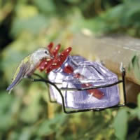
In wanting to view the tiny jewels close up, window hummingbird feeders provide the perfect opportunity. There are many models to choose from, most in a basin style, providing a no-drip feeder.
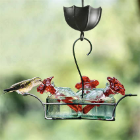
Another option for close up viewing is a deck-mount hummingbird feeder (shown above). It attaches easily to any deck rail, and still provides that great, “up close and personal” view of tiny hummingbirds in your yard.
Simple Nectar Recipe: 1 part sugar to 4 parts water…nothing else in the mix as it will harm hummingbirds.
Boiling the water is not necessary–bacteria is spread through hummingbirds’ bills at the feeders. Boiling water does make for quicker dissolving of sugar. We boil 1 cup water, mix the sugar and add 3 cups of cold water. The nectar is ready with no cooling time. Store unused portion in the fridge for up to 2 weeks.
-
Cut Feeding Costs with a Hummingbird Feeder
Backyard birding is a wonderful hobby, that for some like me, turns into an obsession! Too many feeders, too many bird baths to fill and clean all the time.
Keeping bird feeders filled can get expensive, especially when using premium foods. Every birdfeeder is equipped with a squirrel baffle…I’ve learned the hard way! When warmer weather approaches and it’s time to put out hummingbird feeders, I know it will only cost pennies to create the nectar hummingbirds adore.
Last season I did a test with commercial red nectar and plain old sugar water…the sugar water mix won! One hummingbird feeder was filled with red nectar, while the other had the home made version. Three times as many hummingbirds went for the sugar water. It convinced me immediately to make my own nectar .
The recipe: 1 cup table sugar to 4 parts water. Could it be any easier? No need to boil the water (bacteria is spread through the birds’ bills at the feeders) but in doing so it dissolves the sugar quicker. I use 1 cup of boiling water until sugar is completely dissolved, then add 3 cups of cold water. There is no cooling time and nectar is ready to go in feeders!
If you do decide to try the recipe, NEVER add anything else to the mixture as it will harm, or even kill hummingbirds.

Birding Tips, Information & News