-
America’s Wild Horses May Finally Have Their Day in Court
Federal Court Gives Green Light To Wild Horse Lawsuit
District Judge Rejects Interior Dept. Motion to Dismiss CaseSacramento, Calif. (April 20, 2011) – In a precedent-setting decision, issued today in the United States District Court, Eastern District of California, Judge Morrison C. England, Jr. rejected the U.S. Department of Interior’s motion to dismiss a lawsuit challenging the roundup and removal of nearly 1,579 wild horses and 159 burros from the Twin Peaks Herd Management Area (HMA) in northeastern California last year.
Judge England also ruled that the plaintiffs – animal protection organization In Defense of Animals (IDA), ecologist Chad Hanson, Ph.D., wild horse sanctuary founder Barbara Clarke, DreamCatcher Wild Horse and Burro Sanctuary, local resident and wild horse enthusiast Linda Hay – have standing to challenge the action and that the case is not moot, despite the fact that the roundup has already taken place. In past wild horse roundup litigation, courts have dismissed claims as moot because the roundups had already concluded, never ruling on the merits on the case.
However, In Defense of Animals et al. vs. Interior Department et al., headed by pro bono legal counsel Rachel Fazio, outlines specific remedies and the ongoing harm plaintiffs suffer from Twin Peaks mustangs being held in captivity in government long-term holding facilities – facilities that the plaintiffs allege are illegal. Fazio argued in her briefs that the case was not moot, in part because the Interior Department could return captured horses to the range.
“The American Mustang is a native wildlife species; few people realize that the western United States is actually the evolutionary birthplace of the horse,” said Rachel Fazio, legal counsel for plaintiffs. “This suit seeks to ensure that, in accordance with the laws of Congress, this majestic species is protected as wild and free-roaming, safe from illegal interference by the BLM and immune to the pressures of the livestock industry and other commercial interests that wish to exploit our public lands.”
Plaintiffs in the litigation include ecologist Dr. Chad Hanson, a researcher at the University of California at Davis and author of numerous scientific studies, Barbara Clarke, wild horse expert and director of the 2,000-acre DreamCatcher Wild Horse and Burro Sanctuary in Northeastern California, the DreamCatcher Wild Horse and Burro Sanctuary itself, ecologist Dr. Chad Hanson, Linda Hay, a local resident who has visited and enjoyed the Twin Peaks horses for the past thirty years, and animal protection organization In Defense of Animals.
“We may finally have a court address the merits of a case challenging wild horse roundups and not dismiss it on technicalities,” said Eric Kleiman, Research Director for In Defense of Animals. “This is a groundbreaking legal decision that could lead to America’s wild horses finally having their day in court.”
In addition, the plaintiffs have appealed to the Ninth Circuit Court of Appeals Judge England’s denial last year of a preliminary injunction to halt the Twin Peaks roundup. The remedy of returning horses to the range was also a critical issue of discussion at a hearing before the Ninth Circuit in San Francisco earlier this year.
Meanwhile, Twin Peaks horses have been scattered across the country at Interior Department’s Bureau of Land Management (BLM) holding facilities, and untold numbers have perished while in captivity.
Plaintiffs have revisited the Twin Peaks area and report difficulty locating wild horses to view in the aftermath of the roundup.
Between August and September 2010 – the hottest months of the year – the BLM removed 1,579 wild horses and 159 burros from the HMA. The roundup was a devastating blow to California’s wild horse and burro population, removing more than one-third of California’s entire mustang and burro population which is estimated to be only approximately 5,000 throughout the entire state. The Twin Peaks HMA encompasses 798,000 acres of public land, yet the BLM allows just 448 to 758 wild horses and 72 to 116 burros to reside in the area. Meanwhile, the agency authorizes up to four times more cattle and nearly seven times more sheep to graze this federally-designated wild horse and burro habitat.
Wild horses comprise a small fraction of grazing animals on public lands, where they are outnumbered by livestock nearly 50 to 1. The BLM has recently increased cattle grazing allotments in areas where wild horses are being removed. Currently the BLM manages more than 245 million acres of public lands of which cattle grazing is allowed on 160 million acres; wild horses are only allowed on 26.6 million acres this land, which must be shared with cattle. The Obama Administration has accelerated the removal of wild horses and burros from public lands in the past year, while Congress just last week approved funding for yet more BLM roundups beginning this July. There are currently more than 36,000 wild horses warehoused in government holding facilities and only 33,000 wild horses free on the range.
In Defense of Animals is an international animal protection organization located in San Rafael, Calif. dedicated to protecting animals’ rights, welfare, and habitat through education, outreach, and our hands-on rescue facilities in Mumbai, India, Cameroon, Africa, and rural Mississippi. For more information, visit www.idausa.org. -
bird house kits for a new york park make-over
 An elementary school in New york City has a great idea that’s going into action! Eighty school children at Village Community School will each assemble their own bird house kit, decorate, paint it and help install all 80 bird house kits in a nearby park.
When administration first contacted us, we were more thrilled with the idea itself, than the net profit from a sale. So much so, a deep discount was offered on the bird house kits, and they received a plethora of extras to further entice birds, and to get the kids more involved while making their project a huge success.
Chickadee, Wren and Eastern Bluebird wooden birdhouse kits were ordered, but 16 packages of assorted nesting materials were graciously added. In addition, there was a wonderful Stokes Bluebird Book, and 24 “Pop-Outz” recycled plastic suet feeders, (which are perfect for offering nesting materials) along with a pamphlet on “attracting nesting birds” for each child to take home.
Although bird feeder kits and bird food were thought not to be a smart idea for the area, we also sent along a few suet cakes and explained there would be no ground waste with which to contend. Now I can’t wait to see pictures of the project in progress or the finished product. Park services will be taking care of the water aspect as far as birdbaths or small ponds, making sure there are ample fresh water sources to help birds thrive. The birds in this area of NYC are getting a great make-over!
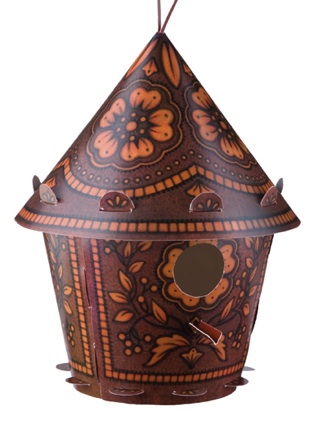
By the way… the tooled leather birdhouse kit shown here is actually recycled plastic-and super fun to assemble. It provides a real nest site for feathered friends and lasts for years to host many successful broods!
-
a very cool hanging bird bath indeed!
 Although birds tend to bathe naturally at ground level, they usually flock to other fresh water sources too. A hanging bird bath is the perfect choice for smaller spaces, or yards where ground predators (cats) tend to lurk.
Fresh water in a bird bath is hands down, one of the best ways to entice more species to your place. If that fresh water happens to be moving… well, it’s like a visual magnet for wild birds! Accessories like water wigglers, leaf misters, and bird bath fountains will absolutely increase the activity around any bath. Hummingbirds for example, are extremely fond of bird bath fountains and bubblers. They can be seen playing and bathing in them on a daily basis if they’re already feeding in your yard.
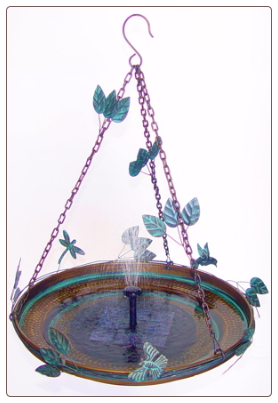
Leaf misters are adored by butterflies and many songbirds too, including bluebirds. The misters are versatile, and may be attached to a plant stake, or a branch, or even a deck or porch with an over-hanging bracket. This hanging bird bath features a solar power mister that’s built right in. The valve is adjustable, so that on windier days a stronger flow or fountain may be used, as opposed to the gentle mist.
Moving water really does attract more birds! This season consider adding some type of water feature to your yard, then sit back and see the difference while helping wild birds thrive.
p.s. use code BB10 at checkout for 10% off any bird bath or bath accessories
good through April 30th 2011.

Birding Tips, Information & News