-
Farming the Cities, Feeding an Urban Future

Worldwatch’s Nourishing the Planet team emphasizes urban agriculture as a means of increasing food security, empowering women, and protecting the environment.
Washington, D.C.-As people move from rural to urban settings in search of economic opportunities, urban agriculture is becoming an important provider of both food and employment, according to researchers with the Worldwatch Institute. “Urban agriculture is providing food, jobs, and hope in Nairobi, Kampala, Dakar, and other cities across sub-Saharan Africa,” said Danielle Nierenberg, co-director of the Institute’s Nourishing the Planet project. “In some cases, urban farmers are providing important inputs, such as seed, to rural farmers, dispelling the myth that urban agriculture helps feed the poor and hungry only in cities.” The United Nations projects that up to 65 percent of the world’s population will live in cities by 2050, up from around 50 percent today. The rate of urban migration is particularly high in sub-Saharan Africa and South Asia, where inadequate urban infrastructure struggles to keep up with the large influx of people. “Although most of the world’s poor and hungry remain in rural areas, hunger is migrating with people into urban areas,” said Brian Halweil, co-director of the Nourishing the Planet project.
Currently, an estimated 800 million people worldwide are engaged in urban agriculture, producing 15-20 percent of the world’s food. However, this activity occurs mainly in Asia, making it critical to place more worldwide emphasis on this vital sector. In Africa, 14 million people migrate from rural to urban areas each year, and studies suggest that an estimated 35-40 million Africans living in cities will need to depend on urban agriculture to meet their food requirements in the future.
“Urban agriculture is an important aspect of the development movement as it has the potential to address some of our most pressing challenges, including food insecurity, income generation, waste disposal, gender inequality, and urban insecurity” said Nancy Karanja, a Professor at the University of Nairobi, Kenya, and a State of the World 2011 contributing author.
Organizations such as Urban Harvest and others are working across the African continent to enhance urban agricultural efforts. In sub-Saharan Africa, the Educational Concerns for Hunger Organization (ECHO), a Florida-based organization, has helped farmers build gardens using old tires and other “trash” to create plant beds. And the group Harvest of Hope has helped organize urban Community Supported Agriculture (CSA) programs in Cape Town, South Africa, purchasing excess produce from city gardens and redistributing it in schools in the area.
“These projects are not only helping to provide fresh sources of food for city dwellers, but also providing a source of income, a tool to empower women, and a means of protecting the environment, among other benefits,” said Mary Njenga, researcher at the University of Nairobi and the World Agroforestry Centre.
According to Nourishing the Planet, urban agriculture provides three important advantages that are evident in successful projects across the African continent:
· Close to home (and market). Produce from urban farms and gardens does not need to travel as far as produce grown in rural areas to reach the dining table, which helps to reduce production costs, post-harvest waste, and greenhouse gas emissions. This is also helpful in situations when supply chains from rural areas have been interrupted and cities are unable to receive food imports.
· Empowering women and building communities. In Kibera, the largest slum in Nairobi, Kenya, Urban Harvest has helped women build “vertical farms” simply by using sacks of soil in which to grow vegetables. Using these gardening activities, the women share business ideas and technical know-how, empowering each other. The community gardens also act as a forum where community members can exchange ideas and discuss community issues and problems.
· Improving urban environments. Faced with limited resources, urban farmers are adept at utilizing urban waste streams to strengthen their soil and grow their crops. Garbage is used as compost or fodder for livestock, and nutrient-rich waste water is used for irrigation. By re-using these waste products, urban farms help to reduce the amount of refuse clogging landfills as well as the amount of water used in cities. Community gardens also provide an aesthetically pleasing space and help improve the air quality in urban areas.
Nourishing the Planet (www.NourishingthePlanet.org) is a two-year evaluation of environmentally sustainable agricultural innovations to alleviate hunger. Worldwatch researchers traveled to 25 countries across sub-Saharan Africa to meet with more than 350 farmers groups, NGOs, government agencies, and scientists, highlighting small-scale urban agricultural efforts that are helping to improve peoples’ livelihoods by providing them with food and income. The findings are documented in the recently released report, State of the World 2011: Innovations that Nourish the Planet.
State of the World 2011 is accompanied by informational materials including briefing documents, summaries, an innovations database, videos, and podcasts, all available at www.NourishingthePlanet.org. The project’s findings are being disseminated to a wide range of agricultural stakeholders, including government ministries, agricultural policymakers, and farmer and community networks, as well as the increasingly influential nongovernmental environmental and development communities.
About the Worldwatch Institute:
Worldwatch is an independent research organization based in Washington, D.C. that works on energy, resource, and environmental issues. The Institute’s State of the World report is published annually in more than 20 languages. For more information, visit www.worldwatch.org.
-
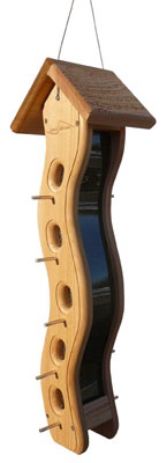
A Groovy kind of tube bird feeder
 You might call this a hopper type bird feeder, but it has perches and there’s no tray at the bottom. You could call it a tube bird feeder, but it really doesn’t resemble one of those either.
We call it the Wave Bird Feeder because of the groovy design. Hand crafted cedar and superb quality, this tube bird feeder is available for black oil sunflower and thistle seed too. With ten feeding ports and a four-pound capacity, it will entice many a feathered friend!
A quality tube bird feeder like this is a good investment for any backyard bird habitat. For use year-round, seed stays protected from the elements. If squirrels are a problem in your yard, a baffle is highly recommended to protect the feeder. Whether feeding sunflower or thistle, you can bet your birds will approve!
-
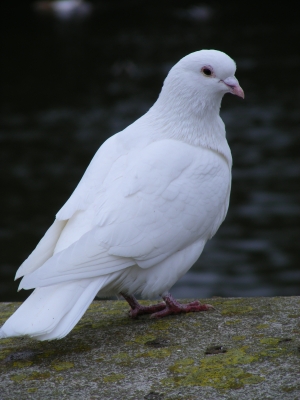
seed catchers and white doves
 What might seed catchers have to do with white doves? Absolutely nothing, except this post was going to be about the benefits of seed catchers… until I received a strange phone call from a customer this morning.
A request was made for an 8 x 8 birdhouse for white doves. Now from a past experience I told the person that doves aren’t likely to use birdhouses. He proceeded to tell me he was purchasing fourteen white doves from a rental company. This piqued my curiosity, so I asked him “why would you do that?” His answer was to keep his niece happy. So I asked “how old is your niece?” “she’s two years old” he said. My suggestion was that he purchase some stuffed animal white doves for her instead.
It turned out he needed an eight foot by eight foot enclosure to keep the doves housed. I asked him to look-up bird aviary on the web to get an idea of what he would need. He proceeded to tell me “four grand a pop”. So I reminded him this would be an expensive, and time consuming endeavor, besides the fact doves are not pets. I can only hope I deterred him in his final decision.
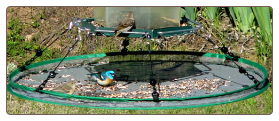
Oh yeah… and here’s a great seed catcher that’s adjustable for hanging or pole-mounted feeders.
 The SeedHoop is a large, 30-inch diameter tray that is very effective at catching spilled seed… and even doves (mourning doves that is ) will rest and eat on the large open surface. Maybe seed catchers and doves do have something to do with each other after all?

Birding Tips, Information & News