-
Confessions from the Mealworm Feeder
 Addiction can be a terrible thing… and I fear that feeding worms has actually become one!
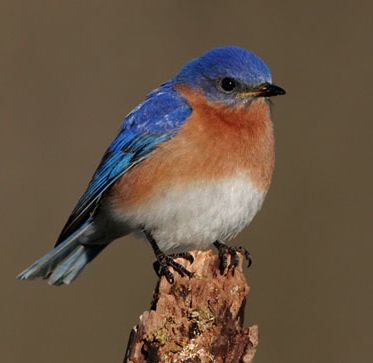
So the worms are meant for this guy, his spouse and kids. Okay, the chickadees can have some, the titmice can too because they have nestlings to feed. Brown headed nuthatches stick around their box long after babies have fledged, they’re too much and may need a permanent address? For the first time phoebe finally has a family (that I’ve actually seen anyway) so of course they must take turns at the mealworm feeder – may you grow strong and thrive little phoebes!
Cardinals won’t touch worms… until they have babies to feed. The catbirds are simply out of hand, wish they’d just stick to the grape jelly! Have you ever seen 20,000 meal worms in a plastic shoe box heading for dormancy in the fridge? It’s become the norm as live worms cost less when buying in bulk. The worms aren’t bad, but the overnight shipping can kill ya!

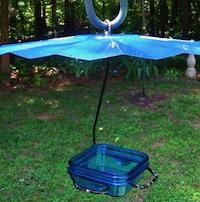
Using this open dish as one of the mealworm feeders is really just asking for it, but babies can’t figure out the enclosed bluebird feeders, or jail type ones with open grid cage. Carolina wrens certainly can, they’re always the first to figure out any new feeder containing mealies!
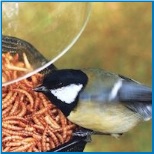
 Screen feeders are nice and easy to use for humans and birds alike… but the worms crawl out! Anything with texture or tooth worms can grip allows cling and crawl action! No worries, anyone who drops to the ground meets their fate by a robin or thrasher just waiting below for the great escape!
So the addiction? The grower must think I eat worms myself, the quantity has now increased to 25,000 worms a pop… and this is every four weeks or so. And I wonder why I’m broke?
-
Bitter Morning’s Breakfast Menu with Extra Goods for the Mealworm Feeder!
 The birdie menu was heavy with special treats today as frigid temperatures almost did my own hands in while feeding! Fingers actually stinging, they had to be warmed by the vent to feel them again. You may say ha… it’s Atlanta and not that bad… wanna bet?
A balmy 5 degrees right now, there’s no chance of leaving the mealworm feeder filled for dawn… the poor little mealies will freeze. That’s what happened last night 🙁
Actually, this is a pretty normal AM feeding, because if there’s too much food out, the nasty starlings hog it all, so daily rations are fed twice instead. Plus everything’s freezing right now.
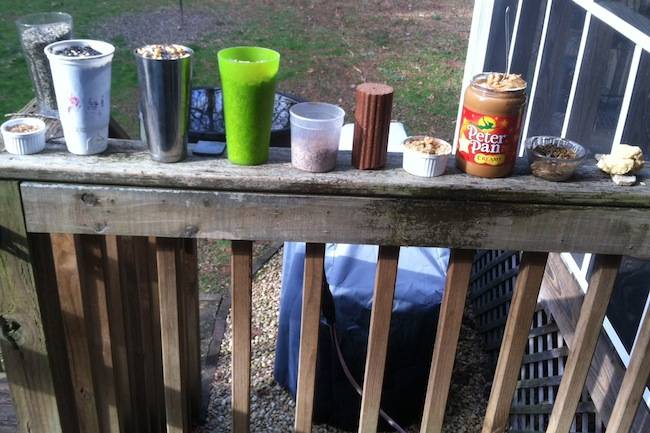
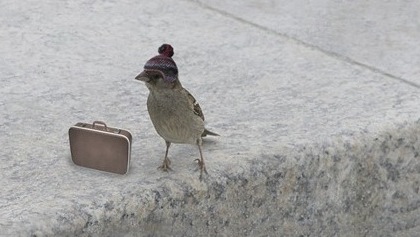
Not an ad for Peter Pan either, this is absolutely the normal routine, (for the birdhouse chick anyway) just happen to snap a photo of it today.
So, what exactly does this backyard bird fanatic feed? From right to left, here goes:
- Finch mix, consisting of finely chopped sunflower and thistle. Lots of goldfinches, just not gold right now.
- Small cup of live worms for the new enclosed mealworn feeder… take that starlings! Carolina wrens are usually first to figure out these feeders.
- Large cup of cardinal mix for the platform feeder.
- Large cup of critter mix for the squirrels and a few other birds.
- Large cup of sunflower hearts/shelled peanut mix for platform feeder #2.
- Live worms for two hanging dish-style mealworm feeders. Meant for the bluebird pair and eastern phoebe, but many others partake.
- Sweet corn squirrel log, which is equal to about 12ears of regular corn cobs. These must be tightened up every few days as our crafty critters have managed to steal them from time to time!
- Small cup of bluebird banquet, suet-like mixture that’s easy to make. Check our site (under birding resources) for this recipe and more.
- Peanut butter, slapped right on tree bark is great for squirrels and birds. High in fat and protein, these extra calories provide energy needed to stay warm.
- Re-hydrated meal worms for yet another dish-style feeder. Boiling water added to dry worms , steep and drain.
- Bark Butter and suet slice for the woodpecker feeder.
- Note the heated bath behind the food, and the cord running across the yard for heated bath #2 of five. Too many feeders to s
 how pics, let’s just say there’s a good mix!
Seriously… who would make up this stuff? We spend a lot of time fussing over our birds – but it’s so worth having them around. It was so cold today that the squirrels didn’t even venture out until late afternoon.
Say you have only one bird feeder, that’s perfect too, just remember the water! Birds need a fresh water source even in the coldest weather. As far as Mr. Arctic Mass, you are not welcome in the South, so please go home now!
-
new guests at the mealworm feeder
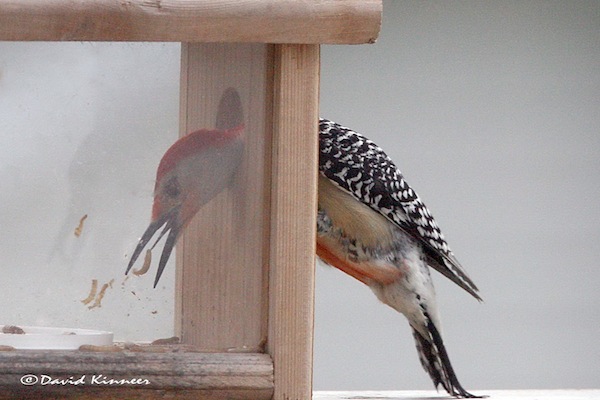
 Killer photo… thanks David for letting us use it for this post. A red bellied woodpecker spears a snack of worms with that long tongue!
The conversation centered around this photo had nothing to with mealworm feeders, but rather birds’ tongues. Yup, of all bird species, it’s only the woodpecker and hummingbird who can actually stick out their tongue! And the limited range of movement is straight forward at that.
Box, dish, tray, cup, cage, staked, hanging, pole-mount and so on… there all kinds of feeders for offering mealworms. Live worms may find escape from open feeders, but it’s not the only reason the box or cage styles are popular. Just about every bird around will eat your worms (and pretty darn fast), so if the intention is feeding bluebirds… enclosed models are basically referred to as bluebird feeders, and they may be hung, pole-, or post-mounted.
This kind of mealworm feeder keeps most birds out, as very few will actually enter a box to retrieve food. The entry/exit is sized the same as that of a bluebird house, although chickadees, carolina wrens and nuthatches will use these feeders if/when live worms are discovered!
In our quest for bluebirds several years ago, housing and fresh water didn’t seem like enough. Up went the mealworm feeder, with every kind of bluebird food out there! It wasn’t until live worms became available on a daily basis the blues finally stuck around. Since then, a Gilbertson nest box and a another NABS approved wooden house have hosted many successful broods over the years. It takes an open habitat, with good perches for hunting insects. As for the hawks who nest nearby in the woods… we could all do without them 🙁 By the way, three woodpecker species totally ignore both open-dish mealworm feeders in our yard, preferring suet and nuts over live worms. Just one of the many reasons we found this photo so very cool!

Birding Tips, Information & News
 Killer photo… thanks David for letting us use it for this post. A red bellied woodpecker spears a snack of worms with that long tongue!